

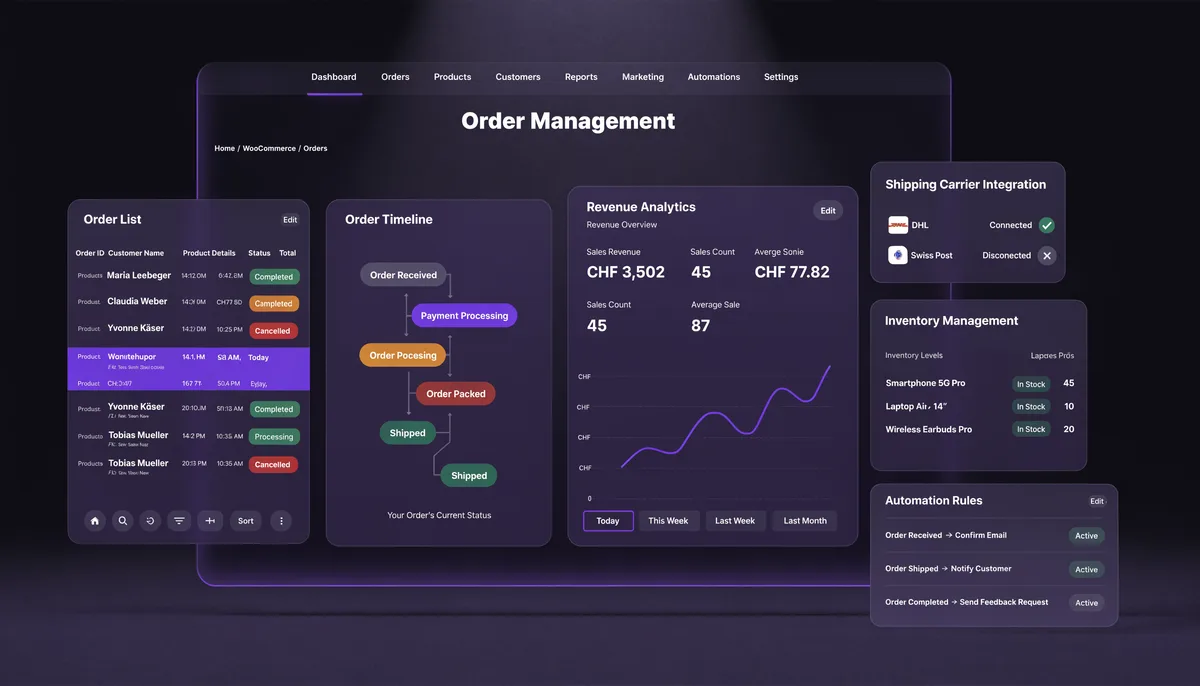
Discover how headless WooCommerce with Next.js delivers blazing-fast e-commerce for German markets in 2026. REST API strategies, hosting, and real-world architecture.
German online shoppers have little patience for slow storefronts. With Core Web Vitals now a confirmed ranking signal and conversion rates dropping roughly 7% for every additional second of load time, technical architecture is no longer a back-end concern — it is a revenue decision. Headless WooCommerce powered by Next.js has moved from an experimental curiosity to a production-ready strategy that forward-thinking DACH merchants are adopting at scale in 2026.
What Does 'Headless WooCommerce' Actually Mean?
Traditional WooCommerce couples the WordPress PHP template layer directly to the data layer. Every product page, cart interaction, and checkout step triggers a full server round-trip. Headless commerce decouples these concerns: WooCommerce becomes a headless backend — a pure data engine exposed via the WooCommerce REST API — while a separate JavaScript frontend, in this case Next.js, handles all user-facing rendering.
The result is a frontend that can be statically generated at build time, server-side rendered on demand, or incrementally regenerated — giving developers fine-grained control over performance that a monolithic WordPress theme simply cannot match.
Why Next.js 15 Is the Right Frontend for WooCommerce in 2026
Next.js 15 introduces partial pre-rendering (PPR), which combines static shell delivery with streaming dynamic content — a perfect match for product catalogues that are mostly static but contain real-time stock levels and personalised pricing. The App Router architecture enables nested layouts, React Server Components, and granular caching at the fetch level.
- Partial Pre-Rendering (PPR) serves a static shell in milliseconds while dynamic fragments stream in
- React Server Components reduce client-side JavaScript bundle size by up to 60%
- Built-in Image optimisation with next/image eliminates layout shift on product galleries
- Edge Runtime support puts your storefront closer to shoppers in Frankfurt, Vienna, and Zurich
- Incremental Static Regeneration (ISR) keeps product pages fresh without full rebuilds
Choosing Between SSG, SSR, and ISR for Product Pages
For large catalogues (10,000+ SKUs), full static generation is impractical at build time. The recommended 2026 pattern is ISR with a short revalidation window (60–300 seconds) for product detail pages, combined with on-demand revalidation triggered by WooCommerce webhooks whenever price or stock data changes. Category pages benefit from longer TTLs — they change less frequently and are the highest-traffic entry points from organic search.
WooCommerce REST API: Performance Strategies That Matter
The WooCommerce REST API v3 is powerful but verbose. A single product endpoint can return 80+ fields when your storefront only needs 12. Left unchecked, over-fetching adds hundreds of milliseconds to every build and runtime request. These strategies keep API performance tight:
- Use the `_fields` query parameter to request only the fields your frontend actually renders
- Implement Redis object caching on the WordPress host — tools like Cloudways make this a one-click configuration
- Wrap expensive endpoints in a Next.js Route Handler acting as a lightweight BFF (Backend for Frontend) with in-memory caching
- Enable persistent HTTP connections and gzip compression on the WordPress server
- Use webhook-triggered ISR revalidation instead of polling the API on a fixed schedule
Authentication and Security for Headless Setups
Consumer keys and secrets are fine for server-side API calls inside Next.js Route Handlers, but never expose them to the browser. For user-specific operations — cart, orders, account data — implement JWT authentication using the WP REST API – JWT Authentication plugin. Store tokens in HTTP-only cookies, not localStorage, to protect against XSS attacks — a requirement that German data protection auditors increasingly scrutinise.
Hosting Architecture for DACH Performance
A headless stack splits hosting across two layers, and each deserves careful selection. The WordPress/WooCommerce backend needs a managed host optimised for PHP and MySQL with a data centre in Germany or the EU to satisfy GDPR data residency expectations. Cloudways on DigitalOcean's Frankfurt node has become a popular choice among German agencies — it offers Redis, PHP 8.3, and a Breeze cache plugin tuned for WordPress, all on an infrastructure that supports vertical scaling without downtime.
The Next.js frontend deploys best on a global edge network. Vercel's Frankfurt edge node, Netlify's EU region, or Cloudflare Pages all deliver sub-50ms TTFB to Central European users. Because the frontend is statically served at the edge with only API calls hitting your origin, backend traffic drops dramatically compared to a traditional WooCommerce setup.
CDN Strategy for Product Images and Assets
Product imagery is often the biggest performance bottleneck. Use WordPress's built-in media library as the source of truth but serve images through a CDN with aggressive cache headers. Next.js's `next/image` component handles format negotiation (WebP, AVIF) and responsive sizing automatically when you configure a remote image pattern pointing to your CDN origin. This alone can cut Largest Contentful Paint by 40–60% on product detail pages.
Handling Cart and Checkout in a Headless Setup
Cart state is the hardest problem in headless WooCommerce. The WooCommerce Store API (introduced in WooCommerce 6.x) is the modern solution — it provides session-based cart management without requiring authentication and is specifically designed for decoupled frontends. For merchants who want a battle-tested checkout experience without rebuilding it from scratch, SureCart offers a headless-friendly checkout SDK that handles payment processing, tax calculation, and order management, reducing the custom development surface significantly.
For complex B2B scenarios — tiered pricing, quote workflows, approval chains — the WooCommerce REST API combined with custom endpoints registered via `register_rest_route()` gives you the flexibility to model any business process. Pair this with a state management library like Zustand or Jotai on the Next.js side for predictable, testable cart logic.
DSGVO Compliance in a Headless Architecture
German merchants face strict requirements under the DSGVO (GDPR). A headless frontend does not automatically inherit the cookie consent and tracking controls of a WordPress plugin. You must implement a compliant Consent Management Platform (CMP) at the JavaScript layer. The Borlabs Cookie plugin can expose a consent API that your Next.js frontend reads before firing analytics scripts. Ensure your DSGVO check covers both the WordPress backend and the Next.js frontend — our DSGVO Check Tool can help identify gaps quickly.
Real-World Performance Results and Business Impact
Merchants who have migrated to a headless WooCommerce architecture consistently report significant improvements across key metrics. While every project differs, the following benchmarks reflect real-world outcomes from 2025–2026 migration projects in the DACH region:
- LCP improved from an average of 4.2s to under 1.8s on mobile after adopting Next.js with ISR and edge hosting
- Time to Interactive dropped by 55–70% due to smaller JavaScript bundles from React Server Components
- Organic search impressions increased 20–35% within six months of achieving green Core Web Vitals
- Cart abandonment rates fell by 8–12% as perceived speed improved across the checkout funnel
- Server infrastructure costs decreased despite higher traffic, because edge caching absorbed the majority of requests
Is Headless WooCommerce Right for Your Store?
Headless architecture introduces real complexity. You are now maintaining two codebases, two deployment pipelines, and a distributed system with network boundaries between them. For stores with fewer than 500 SKUs, modest traffic, and limited development resources, a well-optimised traditional WooCommerce setup with a performance-focused theme like GeneratePress may deliver 90% of the performance gains at 20% of the engineering cost.
Headless makes compelling sense when you need: multi-channel commerce (app, kiosk, and web from one backend), content-heavy storefronts where editorial flexibility matters, very high traffic that benefits from edge caching, or teams with existing React expertise. If you are unsure which architecture fits your roadmap, our WooCommerce development team can assess your specific requirements and recommend the right path forward.
Ready to Build a Headless WooCommerce Storefront?
Our WooCommerce architects design and deliver headless storefronts built for DACH performance standards. Get a tailored architecture review for your store.
Talk to a WooCommerce Expert