

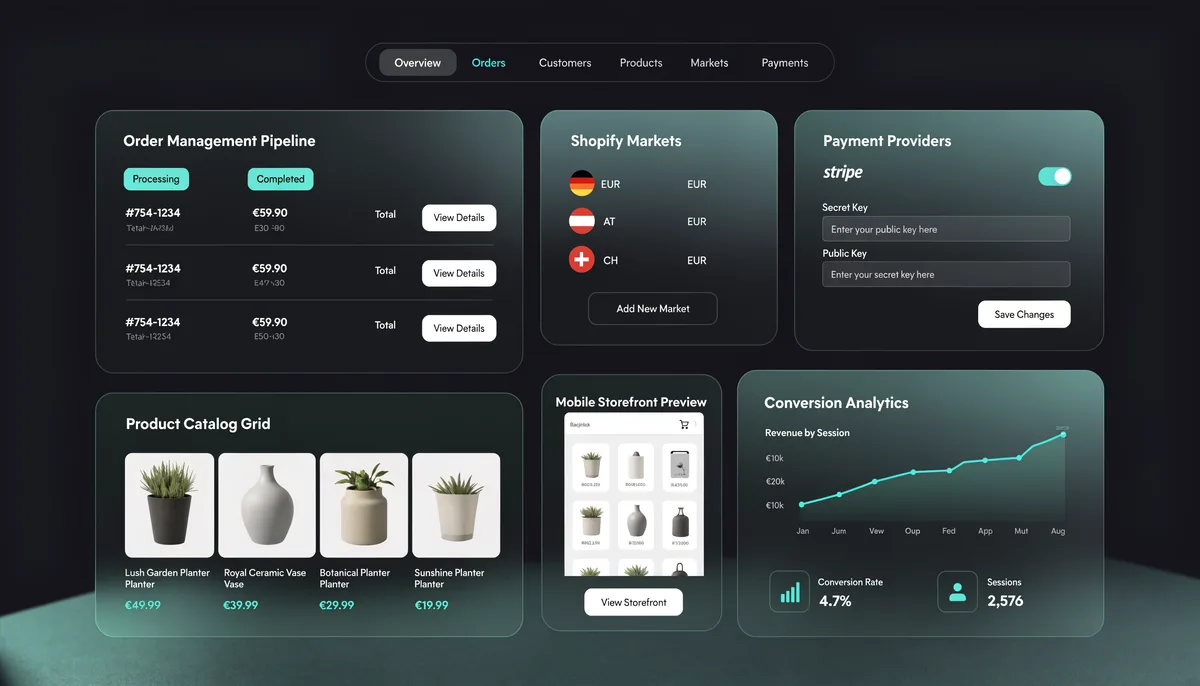
Set up Shopify for the German market in 2026. Complete guide covering VAT configuration, Klarna payments, GDPR compliance, and localization for DACH merchants.
Launching a Shopify store for the German-speaking market is one of the most rewarding — and most complex — e-commerce challenges in Europe. Germany, Austria, and Switzerland collectively represent one of the continent's largest online retail markets, but each country comes with its own tax rules, payment preferences, and legal requirements. This guide walks you through every critical configuration step for 2026, from VAT registration to Klarna integration and full GDPR compliance.
Why the DACH Market Demands Special Shopify Configuration
German consumers are notoriously detail-oriented. They expect legally compliant invoices, local payment methods like SEPA direct debit and Klarna, fully translated storefronts, and a clear privacy policy that meets the standards of the DSGVO (Germany's implementation of GDPR). A store that works perfectly for US or UK customers can fail spectacularly in Germany if these fundamentals are ignored. Before you touch a single product listing, get your legal and tax foundation right.
- Germany has a standard VAT rate of 19% and a reduced rate of 7% for certain goods
- Austria applies 20% standard VAT; Switzerland is not in the EU and uses different VAT rules
- SEPA direct debit, Klarna, and PayPal dominate German payment preferences
- German courts have historically issued costly warnings (Abmahnungen) for non-compliant online shops
- Cookie consent is strictly enforced — implied consent is not acceptable under German law
Step 1: VAT Configuration for Germany and the DACH Region
Setting up VAT correctly in Shopify is the single most important technical step for DACH compliance. Navigate to Settings → Taxes and Duties in your Shopify admin. For Germany, you need to register for a German Umsatzsteuer-Identifikationsnummer (USt-IdNr.) before you can legally charge German VAT. Once registered, add Germany as a tax region and set the standard rate to 19%. For digital products and services sold to German consumers, the VAT applies from the first euro under EU rules as of 2021.
Registering for German VAT
If your business is established outside Germany but sells to German customers, you may need to register via the OSS (One-Stop-Shop) scheme administered through your home EU member state. Non-EU businesses, including those in the US and Switzerland, must register directly with the German Bundeszentralamt für Steuern. The official OSS information is available at the EU Commission portal. NEXITO MEDIA strongly recommends working with a German tax advisor (Steuerberater) for this step.
Configuring Reduced VAT Rates
Certain product categories in Germany attract only 7% VAT — notably books, food items, and some medical products. In Shopify, you can assign tax overrides at the product level. Go to a product, scroll to the Pricing section, and use the Tax overrides feature to assign the correct rate. Keeping this accurate is essential: charging the wrong VAT rate exposes you to penalties from German tax authorities.
Step 2: Integrating Klarna as a Payment Method
Klarna is the dominant buy-now-pay-later and invoice payment provider in the DACH region. German consumers expect to see 'Kauf auf Rechnung' (purchase on invoice) at checkout — a payment method Klarna facilitates natively. To add Klarna to your Shopify store, go to Settings → Payments and look for Klarna under Alternative payment methods, or use the Klarna app from the Shopify App Store if you are not using Shopify Payments.
Shopify Payments vs. Klarna App
If your business is registered in Germany and you have activated Shopify Payments, Klarna is often available as an integrated option within the Shopify Payments dashboard — no separate contract needed. However, businesses registered outside the supported Shopify Payments countries need to use the standalone Klarna app and obtain a direct merchant agreement with Klarna. Check Klarna's official merchant documentation for the current list of supported regions and integration options.
Other Essential German Payment Methods
- PayPal — still the most-used online payment method in Germany
- SEPA Direct Debit — essential for subscription businesses and B2B
- Sofortüberweisung (Sofort by Klarna) — real-time bank transfer widely trusted in Germany
- Giropay — declining but still present in older demographics
- Credit cards (Visa/Mastercard) — important but less dominant than in other markets
Step 3: GDPR and DSGVO Compliance for Shopify Stores
The GDPR (known as DSGVO in German) is enforced aggressively in the DACH region. Your Shopify store needs a robust cookie consent mechanism, a comprehensive privacy policy (Datenschutzerklärung), and an imprint page (Impressum) — the latter being a legal requirement unique to German-speaking countries. Shopify's built-in privacy features are a starting point, but they are not sufficient for full German compliance.
Cookie Consent Banner
German data protection authorities require opt-in consent for non-essential cookies before any tracking scripts fire. Shopify's default cookie banner does not meet this standard. You need a third-party Consent Management Platform (CMP). Borlabs Cookie is one of the most widely trusted CMPs in the DACH market and integrates with Shopify via a custom script injection. Ensure your CMP blocks Google Analytics, Meta Pixel, and all marketing scripts until explicit consent is given.
Impressum and Datenschutzerklärung
Every German online shop must have an easily accessible Impressum listing the full legal name, address, phone number, email, commercial register number, and VAT ID of the business operator. The Datenschutzerklärung must describe every data processing activity in plain language. Tools like the Datenschutz-Generator by Dr. Schwenke can help draft compliant privacy policies, but always have them reviewed by a German legal professional. Add both pages to your Shopify footer navigation immediately.
Step 4: Localization — Language, Currency, and Translations
A storefront in English alone will lose a significant portion of German, Austrian, and Swiss customers. Full German localization is not optional — it is a conversion requirement. Shopify Markets allows you to create region-specific storefronts with localized currencies (EUR for Germany and Austria, CHF for Switzerland), translated content, and region-specific domain structures like .de or .ch subfolders.
Using Weglot for Professional Shopify Translations
For the fastest and most accurate localization, Weglot is the industry-leading translation app for Shopify. It automatically detects and translates all storefront content — including product descriptions, checkout pages, and email notifications — into German and other languages. Weglot also gives you full control to manually edit machine translations, which is critical for product names, legal texts, and brand messaging. It supports hreflang tags out of the box, which is essential for international SEO targeting the DACH region.
Currency and Pricing for DACH
- Use Shopify Markets to set EUR as the default currency for Germany and Austria
- Configure CHF pricing separately for Switzerland — do not just convert EUR at live rates
- Display prices including VAT (Bruttopreise) — this is legally required for B2C sales in Germany
- Consider offering .de and .at subfolders or subdomains for SEO and trust signals
- Update your shipping zones to reflect DACH-specific rates and carriers like DHL, Hermes, and DPD
Step 5: Legal Pages, AGB, and Widerrufsbelehrung
Beyond the Impressum and privacy policy, German e-commerce law requires you to publish AGB (Allgemeine Geschäftsbedingungen — General Terms and Conditions) and a Widerrufsbelehrung (cancellation policy) that meets the requirements of the EU Consumer Rights Directive as implemented in German law. The Widerrufsbelehrung must clearly state that consumers have 14 days to return goods without giving a reason. A missing or incorrect cancellation policy is one of the most common grounds for costly Abmahnungen in Germany. Use a specialist provider like Händlerbund or Trusted Shops to generate and maintain legally current versions of these documents.
Step 6: Technical SEO and Performance for the German Market
German search behavior differs from English-language markets. Users search in German, and Google.de prioritizes fast, mobile-optimized, locally relevant results. Ensure your Shopify theme is performance-optimized — Core Web Vitals scores directly impact rankings. Use Weglot to ensure hreflang tags are correctly implemented across your DACH subfolders. Submit your German sitemap to Google Search Console under the google.de property. For page speed optimization, consider a lightweight Shopify theme and minimize third-party app scripts. Our SEO Audit Tool can help identify critical performance gaps before launch.
Common Mistakes DACH Shopify Merchants Make in 2026
- Launching without a valid Impressum — risks immediate legal warnings
- Using Shopify's default cookie consent instead of a DSGVO-compliant CMP
- Forgetting to configure 7% reduced VAT for eligible product categories
- Not offering Klarna or SEPA — losing 30-40% of potential conversions
- Displaying prices excluding VAT for B2C customers — illegal under German law
- Failing to translate automated Shopify emails (order confirmation, shipping updates)
- Not setting up a separate Swiss pricing strategy and CHF currency
Need Expert Shopify Setup for the German Market?
Our team specializes in Shopify configuration for DACH merchants — from VAT and Klarna to full GDPR compliance and German localization. Get your store launch-ready the right way.
View Shopify Services