

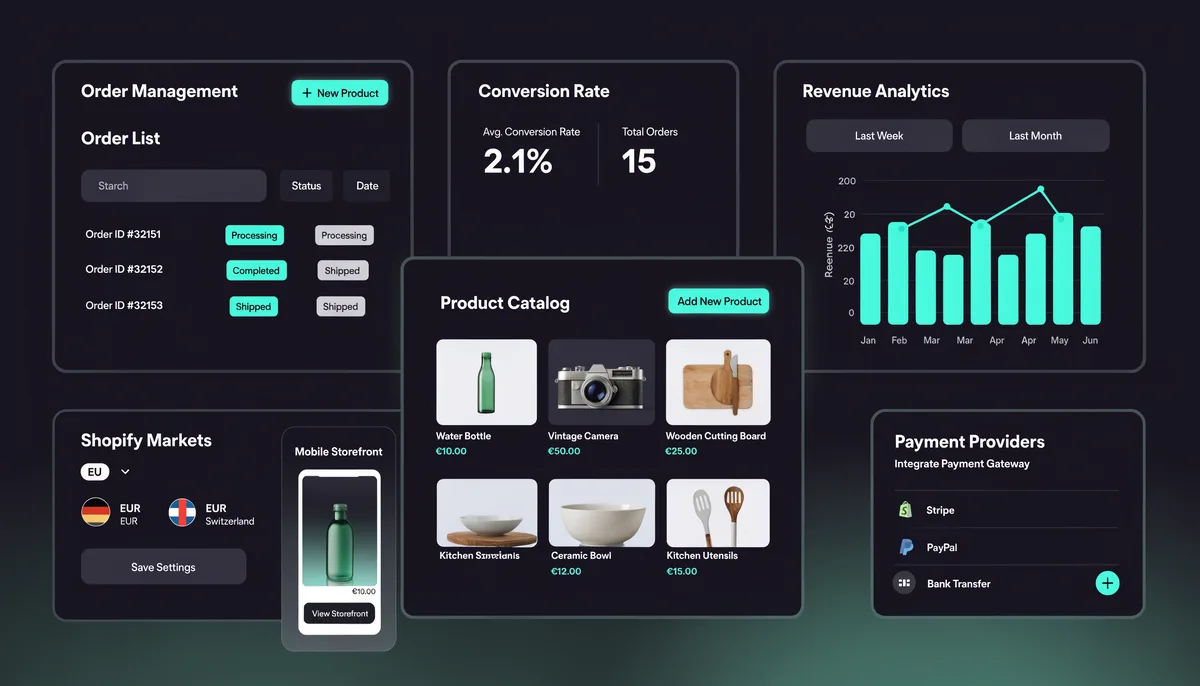
Shopify vs WooCommerce 2026 — an honest, data-driven comparison for German shop owners covering costs, GDPR, scalability, and which platform wins in the DACH market.
Choosing the right e-commerce platform in 2026 is one of the most consequential decisions a German shop owner will make. Shopify and WooCommerce continue to dominate the global market, but their strengths diverge significantly when you factor in DSGVO compliance, payment preferences, local hosting regulations, and the unique buying habits of DACH consumers. This guide cuts through the marketing noise and gives you a real-world comparison so you can invest your time and money wisely.
Market Share and Platform Maturity in 2026
According to W3Techs, WooCommerce still powers roughly 37% of all online stores globally, while Shopify has climbed to about 28% — a gap that has narrowed considerably over the past two years. In the DACH region specifically, WooCommerce has historically dominated due to the prevalence of WordPress and the availability of German-language plugins for invoicing, tax compliance, and checkout customization. Shopify, however, has made aggressive inroads with its 2025 localisation push, including native support for SEPA Direct Debit and improved German tax calculation out of the box.
Why Platform Maturity Matters for Your Business
A mature platform means a larger developer ecosystem, better documentation, and more reliable long-term support. Both Shopify and WooCommerce qualify as mature solutions in 2026. The real question is: which platform's ecosystem aligns with the tools, workflows, and compliance requirements of a German business?
Total Cost of Ownership: The Real Numbers
Pricing is rarely straightforward when comparing these two platforms. Shopify's Basic plan starts at €32/month in 2026, the Shopify plan at €92/month, and Advanced at €384/month — all with transaction fees waived if you use Shopify Payments. WooCommerce itself is free and open-source, but the true cost includes hosting, premium plugins, SSL certificates, and developer time.
WooCommerce Hosting Costs in Germany
For WooCommerce, a reliable managed hosting provider is non-negotiable. Cloudways offers Germany-based data centres (Frankfurt via DigitalOcean or AWS) starting from around €14/month for small stores, scaling to €80–200/month for high-traffic operations. Add premium plugins for invoicing (e.g., Germanized Pro at €79/year), a page builder, and security tools, and you are looking at a realistic annual spend of €800–2,500 for a mid-sized WooCommerce store.
- Shopify Basic (annual billing): ~€384/year — includes hosting, SSL, CDN
- WooCommerce on managed hosting: €168–600/year for hosting alone
- Plugin stack for DACH compliance: €200–600/year additional for WooCommerce
- Shopify Advanced: ~€4,608/year — but zero hosting headaches
- Transaction fees: Shopify charges 0.5–2% if not using Shopify Payments
DSGVO and Legal Compliance: A Critical Factor for German Shops
The General Data Protection Regulation (DSGVO in German) is not optional — it is a legal requirement with fines of up to €20 million or 4% of global annual turnover. This is where many non-German platforms historically stumbled, and it remains a crucial differentiator in 2026.
WooCommerce and DSGVO
WooCommerce running on a German or EU-based server gives you full control over data residency. Plugins like Borlabs Cookie handle cookie consent management in a legally compliant manner, and tools like OMGF let you self-host Google Fonts to avoid GDPR violations from external font calls. The open-source nature of WooCommerce means every data flow can be audited and controlled — a significant advantage for legally cautious German businesses.
Shopify and DSGVO
Shopify stores data on servers primarily located in the United States, which has been a sticking point for German data protection officers since the Schrems II ruling. In 2025, Shopify introduced its EU Data Localisation option for Enterprise plans, but this remains cost-prohibitive for most SMBs. That said, Shopify has signed the EU-US Data Privacy Framework and provides a robust Data Processing Agreement (DPA). For most small-to-medium German shops, Shopify is legally workable — but requires more diligence around cookie consent tools and third-party app data flows.
Payment Methods: Meeting German Customer Expectations
German shoppers are famously conservative with payment methods. According to Statista, PayPal, Rechnung (invoice/buy now pay later), and SEPA Direct Debit consistently rank as the top three preferred methods. Klarna and Giropay also feature prominently.
- Shopify Payments supports PayPal, Klarna, and SEPA Direct Debit natively in Germany since 2025
- WooCommerce integrates with virtually every German payment provider via plugins (Mollie, PayPal, Klarna, Heidelpay)
- Purchase on invoice (Rechnungskauf) is easier to implement natively in WooCommerce via plugins like WooCommerce German Market
- Shopify's checkout customisation for invoice-based payment requires workarounds or third-party apps on standard plans
Scalability and Performance in 2026
Shopify's infrastructure is purpose-built for e-commerce scale. It handles flash sales, Black Friday traffic spikes, and international expansion without you needing to touch a server configuration. WooCommerce, by contrast, requires active performance management — caching, CDN configuration, database optimisation — especially as your product catalogue grows past a few thousand SKUs.
When WooCommerce Scales Well
With the right hosting foundation — such as Cloudways on a cloud VPS — and a well-optimised theme and plugin stack, WooCommerce can comfortably handle tens of thousands of orders per month. The key is proactive infrastructure management and regular performance audits. For stores with complex product configurations, subscription models, or highly customised checkout flows, WooCommerce's flexibility often outweighs Shopify's convenience.
When Shopify Wins on Scale
If you are planning rapid international expansion — particularly into markets outside the DACH region — Shopify Markets is a compelling feature that handles multi-currency, multi-language, and localised tax rules from a single dashboard. For D2C brands scaling from Germany into the EU or US market, this alone can justify the higher monthly cost.
Migration: Moving Between Platforms in 2026
Whether you are migrating from WooCommerce to Shopify or the reverse, the process involves more than just product data. Orders, customer records, SEO metadata, custom integrations, and payment configurations all require careful handling. A poorly executed migration can cost you search engine rankings, customer trust, and revenue.
- Product and category data: Migrated via CSV or apps like Cart2Cart — relatively straightforward
- Customer data: Requires DSGVO-compliant data transfer agreements between platforms
- SEO redirects: Every URL structure change needs 301 redirects — a step that is frequently botched
- Custom integrations: ERP, CRM, and fulfilment systems must be reconnected on the new platform
- WooCommerce-to-Shopify migrations typically take 4–12 weeks depending on store complexity
If you are considering a platform switch, it is worth consulting specialists before you start. The NEXITO MEDIA Shopify migration service provides end-to-end support for German-market stores, covering SEO preservation, DSGVO compliance, and payment gateway reconfiguration.
Verdict: Which Platform Should German Shop Owners Choose in 2026?
There is no universally correct answer — but there is a right answer for your specific situation. Choose WooCommerce if you need maximum control over data, require deep customisation of checkout flows, operate on a tighter budget, and have access to reliable technical support. Choose Shopify if you value operational simplicity, plan to scale internationally, prefer predictable monthly costs, and do not want to manage hosting or server infrastructure. For DACH merchants specifically, the DSGVO compliance overhead of Shopify is manageable but real, while WooCommerce's flexibility comes at the cost of ongoing technical responsibility.
Need Help Choosing or Migrating?
Whether you are evaluating Shopify for the first time or planning a WooCommerce migration, our team can audit your requirements and build a roadmap tailored to the German market.
Talk to a Shopify Expert