

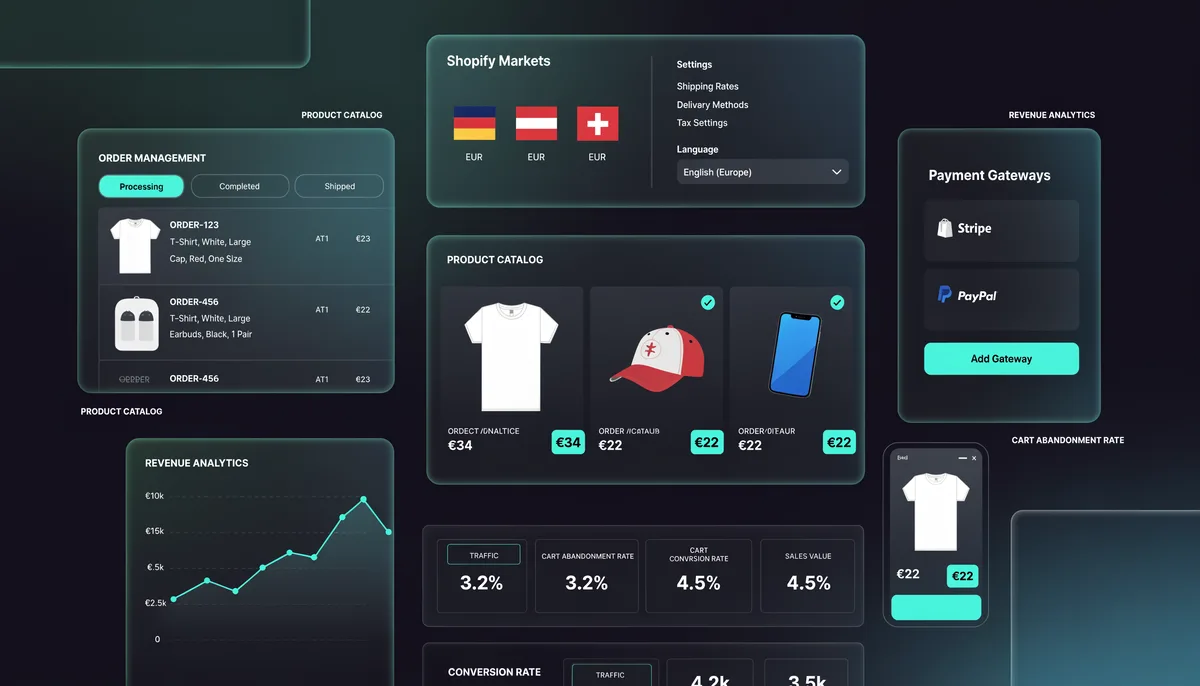
Expand into Germany, Austria, and Switzerland with Weglot 2026. This practical guide covers multilingual Shopify and WordPress setup for successful DACH localization.
The DACH region — Germany, Austria, and Switzerland — represents one of Europe's most lucrative e-commerce markets, with combined online retail revenues exceeding €120 billion annually. Yet for English-speaking store owners and agencies, language remains the single biggest barrier to entry. In 2026, Weglot has become the go-to solution for teams building multilingual Shopify and WordPress stores that are ready to win German-speaking customers from day one.
This guide walks you through everything you need to know: how Weglot works in 2026, how to configure it for Shopify and WordPress, what DACH-specific localization considerations matter most, and how to avoid the common mistakes that cost businesses thousands in lost conversions. Whether you are migrating an existing store or launching fresh into the German market, this is your practical blueprint.
Why the DACH Market Demands True Localization
German-speaking consumers are famously discerning. Studies consistently show that over 75% of DACH shoppers prefer to browse and buy in their native language, and a significant share will abandon a cart if they encounter confusing or machine-translated content. Localization in DACH goes far beyond translation — it encompasses currency formatting, date formats, legal requirements like the Impressum and DSGVO compliance, and culturally appropriate tone of voice.
- German uses formal address ("Sie") in most commercial contexts — your translation must reflect this
- Swiss German and Austrian German have regional vocabulary differences that matter to local buyers
- DACH customers expect DIN-standard date formats (DD.MM.YYYY) and Euro formatting
- Legal pages (Impressum, Datenschutz, Widerrufsrecht) must be linguistically and legally accurate
- Trust signals like "Trusted Shops" and "TÜV" seals resonate strongly in Germany and Austria
What Is Weglot and How It Works in 2026
Weglot is a cloud-based translation and localization platform that integrates directly with Shopify and WordPress via a lightweight script or plugin. Rather than replacing your existing content management workflow, Weglot layers on top of it, intercepting page content, translating it automatically using a combination of DeepL and Google Neural Machine Translation, and then allowing your team to post-edit translations inside the Weglot dashboard.
In 2026, Weglot has introduced several meaningful upgrades. Its AI-powered translation memory now learns from your manual corrections across sessions, meaning the more you use it, the more accurate your store-specific terminology becomes. The platform also now supports hreflang auto-injection for both Shopify and WordPress, which is critical for multilingual SEO — a feature that was previously manual and error-prone.
- Automatic hreflang tag injection for correct language targeting in Google Search
- Visual in-context editor lets translators work directly on the live page
- Translation memory and glossary features ensure brand terminology stays consistent
- Shopify Metafields and WordPress custom fields are now fully translatable
- Multi-subdirectory and subdomain routing options for SEO-friendly URL structures
Setting Up Weglot on Shopify for the DACH Market
If you are building or scaling a Shopify store for German-speaking markets, the setup process starts in the Shopify App Store. Install the official Weglot Translate app, connect your Weglot account, and select German (de), Austrian German (de-AT), and Swiss German (de-CH) as target languages. Weglot will immediately begin crawling and translating your storefront.
Configuring Language Switcher and URL Structure
For DACH expansion, we strongly recommend the subdirectory URL structure — yourstore.com/de/, yourstore.com/de-at/, yourstore.com/de-ch/ — rather than subdomains. This approach consolidates your domain authority and is easier to manage from a DNS perspective. Weglot handles this routing natively in 2026 without requiring any theme code edits.
Translating Product Metafields and Checkout
Shopify's native checkout translation is now partially supported by Weglot via Checkout Extensibility. Make sure your Shopify plan supports Checkout Extensibility (available from Shopify Advanced and above), then map your custom metafields in the Weglot dashboard under "Advanced Settings > Custom Content." Product option names, variant labels, and shipping policy text should all be manually reviewed — these are high-conversion touchpoints where mistranslations are especially costly.
Legal Pages and DSGVO Compliance
Weglot does not generate legally compliant German content — it translates what you provide. For Impressum, Datenschutzerklärung, and Widerruf pages, always have a German-qualified legal professional draft or review the content before publishing. You can use the DSGVO Check tool to audit your compliance posture before launch.
Setting Up Weglot on WordPress and WooCommerce
For WordPress-powered stores and content sites, the Weglot WordPress plugin is available directly from the WordPress plugin repository. After activation, you enter your API key, select your source language (English), and add your DACH target languages. Weglot works with any theme and is fully compatible with Elementor, Gutenberg, WooCommerce, and most popular page builders.
WooCommerce-Specific Configuration
In WooCommerce, pay special attention to product descriptions, attribute names, shipping zone names, and email templates — all of which are translatable via Weglot's exclusion/inclusion rules. Navigate to Weglot Settings > Translations > Translate Emails and enable this feature explicitly. WooCommerce transactional emails in German are a trust-builder that many store owners overlook entirely.
SEO Configuration for Multilingual WordPress
Weglot integrates with Yoast SEO, Rank Math, and All-in-One SEO to translate meta titles, meta descriptions, and Open Graph tags automatically. In 2026, Weglot's SEO sync feature updates translated SEO fields whenever you edit the source language content — eliminating the stale-translation problem that plagued earlier setups. Pair this with a proper XML sitemap that includes all language variants, which Weglot generates automatically when you enable the sitemap option under Settings > SEO.
DACH Localization Beyond Translation: What Weglot Cannot Do Alone
Even the most accurate translation tool cannot replace genuine localization expertise. For DACH markets, consider these additional layers of work that Weglot will not handle automatically: payment method preferences (SEPA, Klarna, and PayPal dominate in Germany), regional shipping carrier expectations (DHL, Hermes, DPD), and seasonal marketing calendars that differ from US or UK norms.
- Add SEPA Direct Debit and Klarna payment options — German shoppers expect them
- Display prices with German number formatting: 1.299,00 € not €1,299.00
- Use the formal "Sie" form throughout all customer-facing copy and email communications
- Include a physical address and phone number on your Impressum — legally mandatory in Germany
- Consider localizing product photography and lifestyle imagery to reflect DACH aesthetics
Performance, Pricing, and Weglot Plan Selection for 2026
Weglot pricing in 2026 is word-count based, which means larger catalogs cost more to translate. For a typical DACH-focused Shopify store with 500 products, you will likely need the Business plan or above. WordPress sites with active blogs will consume translation words faster than static stores, so factor in your content publication frequency when selecting a plan. Weglot's dashboard provides a real-time word count meter that helps you manage usage.
From a performance perspective, Weglot delivers translations via its own CDN, meaning page load impact is minimal. In our testing with Shopify stores, the Weglot script added fewer than 150ms of additional load time on translated pages — well within acceptable thresholds for Core Web Vitals. If you are on a performance-sensitive WordPress setup, consider pairing Weglot with a caching plugin and enabling Weglot's lazy translation loading option.
Common Mistakes to Avoid When Going Multilingual for DACH
- Launching with machine translations only — always budget for human review of key pages
- Ignoring hreflang tags — without them, Google may show the wrong language version to German users
- Translating URLs literally — German URL slugs should be SEO-optimized in German, not translated from English
- Forgetting transactional emails — a German checkout confirmation in English destroys trust
- Using informal "du" address in B2C contexts without researching your specific audience niche
- Overlooking Swiss German (de-CH) — Swiss customers notice when content is clearly aimed only at Germany
Ready to Launch Your DACH Multilingual Store?
NEXITO MEDIA builds and optimizes multilingual Shopify stores for the German-speaking market. From Weglot configuration to full DACH localization strategy, we handle the technical and cultural details so you can focus on growth.
Explore Shopify Services